One of my New Year’s Resolutions was to spend this year visiting museums. First up: a museum I’ve VERY much been looking forward to visiting for years. The one I was most psyched for. And, conveniently, the one closest to my own house. The honor of hosting the grand debut of Helga Without the H’s Official Year of the Museum falls to:
the Alexandria Black History Museum!

Before stopping by the museum, though, I took care of another one of my resolutions and stopped by the Kate Waller Barrett branch of the Alexandria public library to acquire a library card. Huzzah! This was a fitting stopping point before visiting the museum, because it is the location of one of the most important moments in Alexandria black history: the Alexandria Library Sit-in. the sit-in was organized by attorney Samuel Tucker in 1939, many years before the more famous sit-ins started in Greensboro in 1960. The sit-in resulted in the creation of a segregated “separate but equal” black library a few blocks north. Guess what that library is being used as now… that’s right, the Alexandria Black History Museum. The Kate Waller library had an informative plaque out front explaining the sit-in and its aftermath:

The museum is quite small. The main exhibit takes up the original library building, which is a single tiny room. They have a little diorama to illustrate what the interior looked like at that time. Assuming someone put some effort into the accuracy of the display, it’s disheartening to realize how few books had fit into the space (less than my parents have in their house, maybe even less than I have in mine), especially after I’d walked straight over from the white library:
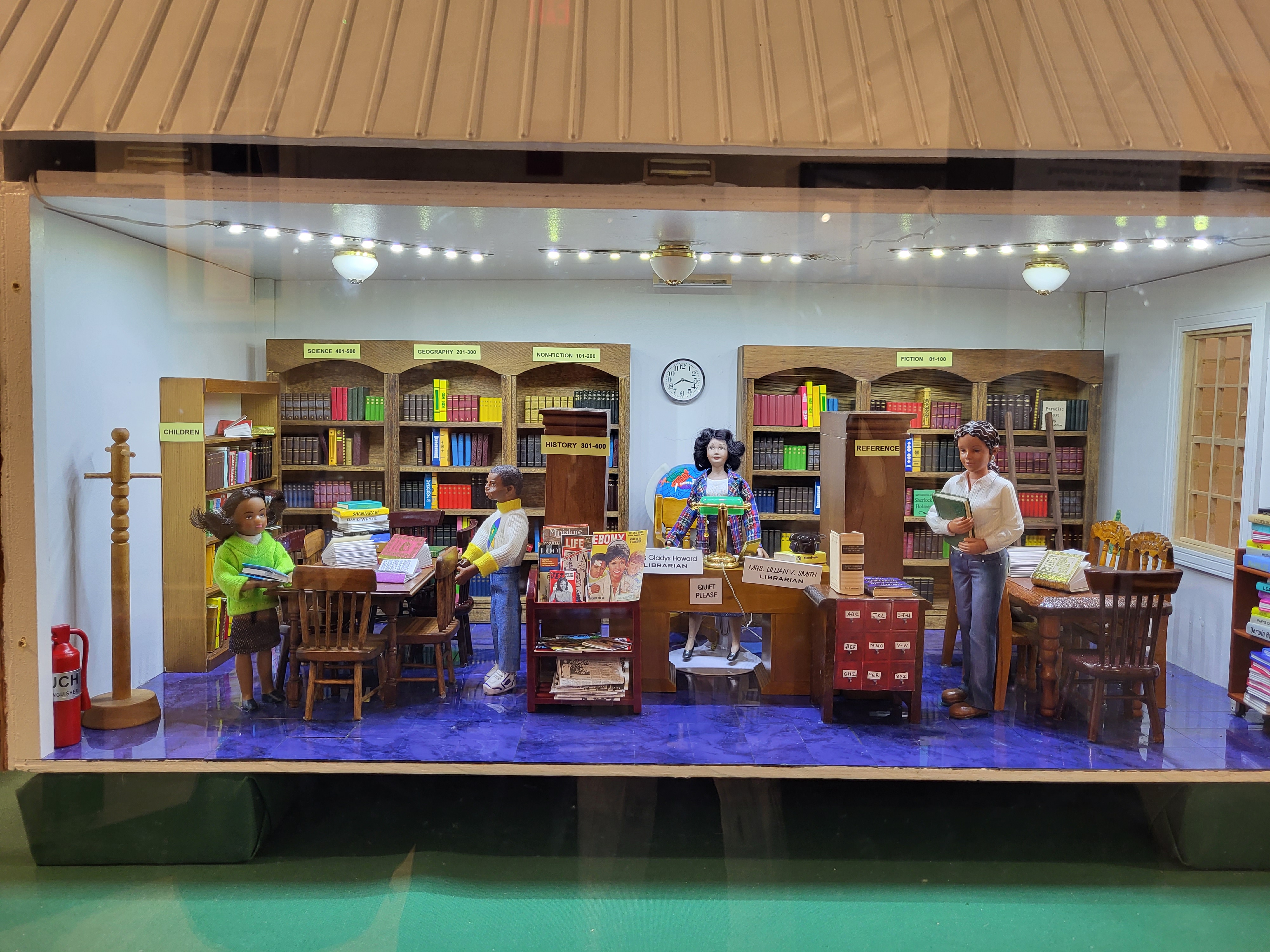
The display also had Samuel Tucker’s law degree, which was neat. And when you enter the museum (which is free for Alexandria residents, but I think only three bucks for non-residents), they asked if I’d like to hear a brief intro, which consisted of pretty much the same little synopsis I gave above about the sit-in and the library.
From that point forward, I’m very sorry to say, I found the museum tragically disappointing. It was lacking in both information and displays. The problem isn’t the small space; the problem was the selection of what to include. Alexandria is a colonial city, with a long and crazy history. Black history has been an integral part of that history at every step of the way. Like… SO MUCH HISTORY! But, of course, most of our history lessons are pretty white-washed, and its up to us to make sure we’re getting the full picture. What better place to go to learn about local black history than the local black history museum? Turns out… there’s very little history to learn here.
I had a similar experience last year when I visited the Freedom House Museum. That museum, also run by the city of Alexandria, is located in the building that housed the largest domestic slave trade business in America. That’s a BIG deal, a huge part of our tragic local history. That’s something about which everyone should learn. Yet the museum had maybe half a room about the slave trade, and this particular business. The rest of the museum consisted of two exhibits: 1. an art exhibit by a woman who painted old slave quarters and other spaces that historically have been significant to black Americans, and 2. A list of plaques about notable black Alexandrians in the 20th century (I think… it’s been a while). First, I thought using up a third of the museum for this art was a bit much. Second, I thought the list of post-slavery notables belonged in the local black history museum, not in the anti-slavery museum. So I was disappointed by how little there was to learn there, but hopeful that, if this is the material we see in this museum, then the displays in the actual local black history museum should be fantastic! (fingers crossed) My hope turned to optimism when a neighbor raved about the museum to me.
What did I find when I walked into the single-room museum that had to cover several centuries of complex, robust history? Half the space was covered by the EXACT SAME art I’d been stuck looking at in the Freedom House Museum. The walls were covered, leaving virtually no space for actual educational material. How many of those paintings were of Alexandrian locations? A whopping zero.
What about physical materials to view? There were only a couple displays of actual objects: a display of objects found in a landfill that probably belonged to an enslaved woman in the 18th century, the above-pictured diorama, and an actually ok interactive kids’ display about life as an enslaved child that asked them questions like “how would you feel if your family was ripped away from you?” and “can you lift this bucket of water?” and “are you too tall to play?” A shelf next to the kids’ display contained a demo Topsy Turvy doll.
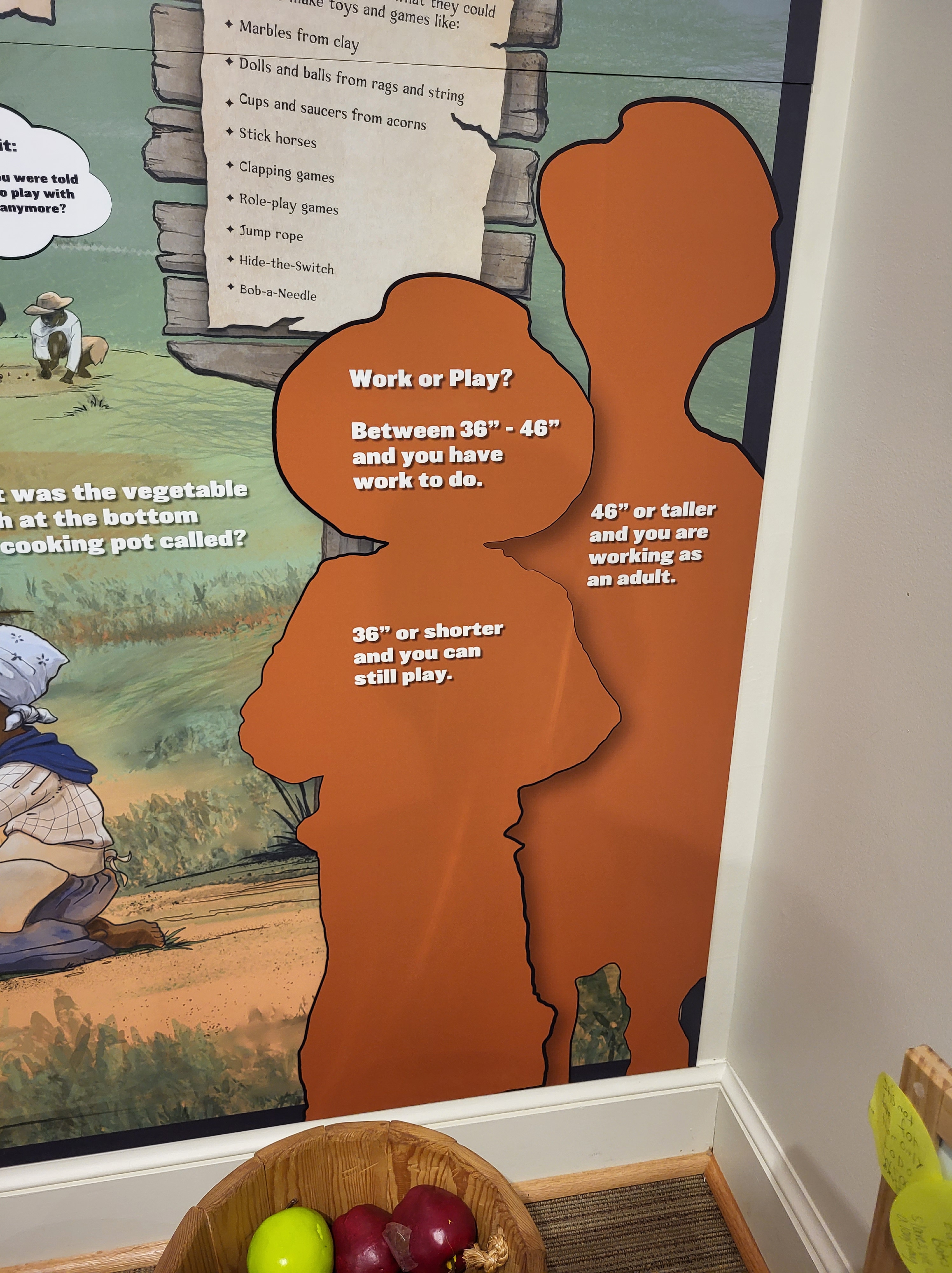
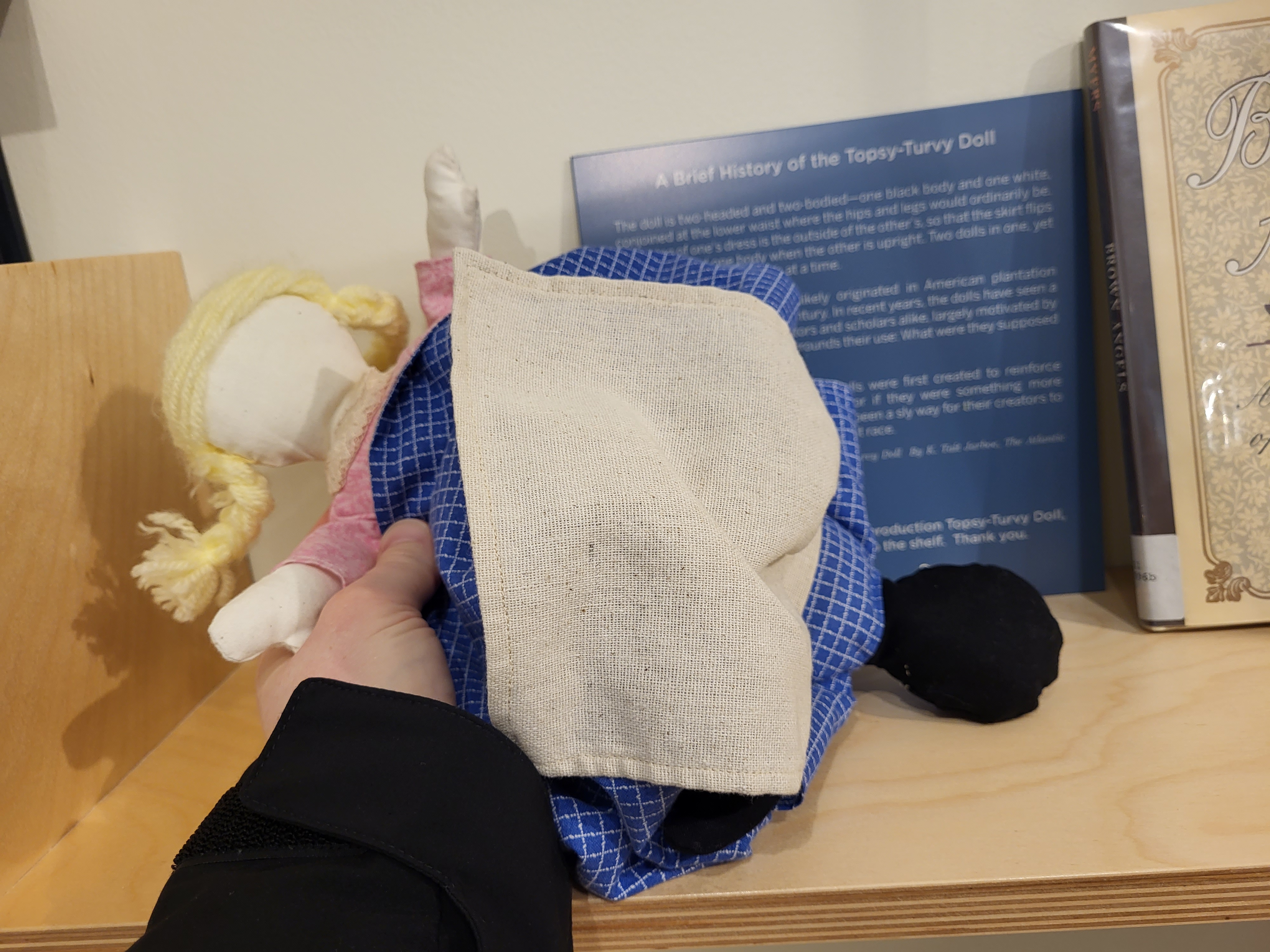
The kids’ display was actually pretty good (though, again, small). But it was about slave life in general, with nothing Alexandria-specific.
So, what were we left with to learn about actual Alexandrian black history? About 10 free-standing panels of info. The first few focused heavily on slave quarters on plantations. It was interesting to learn that there was a movement to improve slave quarter conditions (out of concerns for productivity, not humanity, of course), but that was covered in just a couple sentences. After that we had displays about 3 plantations… that were NOT located in Alexandria. Also, all 3 plantation displays (which are, again, each only a couple sentences long) described the building materials of the slave quarters. The only mention of anyone specific was a woman at Arlington House who saved a bunch of heirlooms, and the accompanying photo was of… her quarters that were made out of brick (which was NOT listed as a building material in our multiple displays entirely about building materials.) So weird.
There was only 1 display about enslaved life in a city. Considering that Alexandria has been a city longer than the US has been a country, and that slavery was in effect for roughly half of its entire history, that this display would be full of info. It stated two things: 1. enslaved people slept in hallways in their enslavers’ houses instead of in separate slave quarters, and 2. sometimes they met and talked in alleys. That’s it! Meanwhile we had 4 panels about plantations outside of Alexandria!
There was one display about how many locations and buildings significant to black Alexandrian residences have been razed, while white-centric buildings have been preserved. Now that’s actually super interesting and important. It listed some examples: Parker Gray high school and its predecessors, black churches (though Alfred Baptist got the most of the attention, and I think even had a separate display in the gift shop/ foyer about the movement to save it), and a black swimming pool named after two children who drowned in the Potomac because, of course, they weren’t allowed in the whites-only pool. This was exactly the sort of hyper-local specific information I was hoping to learn. There is so much attention paid to gentrification and erasure of local history, and I’ve learned a lot by just walking around town and reading historic plaques. So this is exactly what I wanted to learn! But there was just so little of this information! It was so vague and short. Why? Why so lacking?
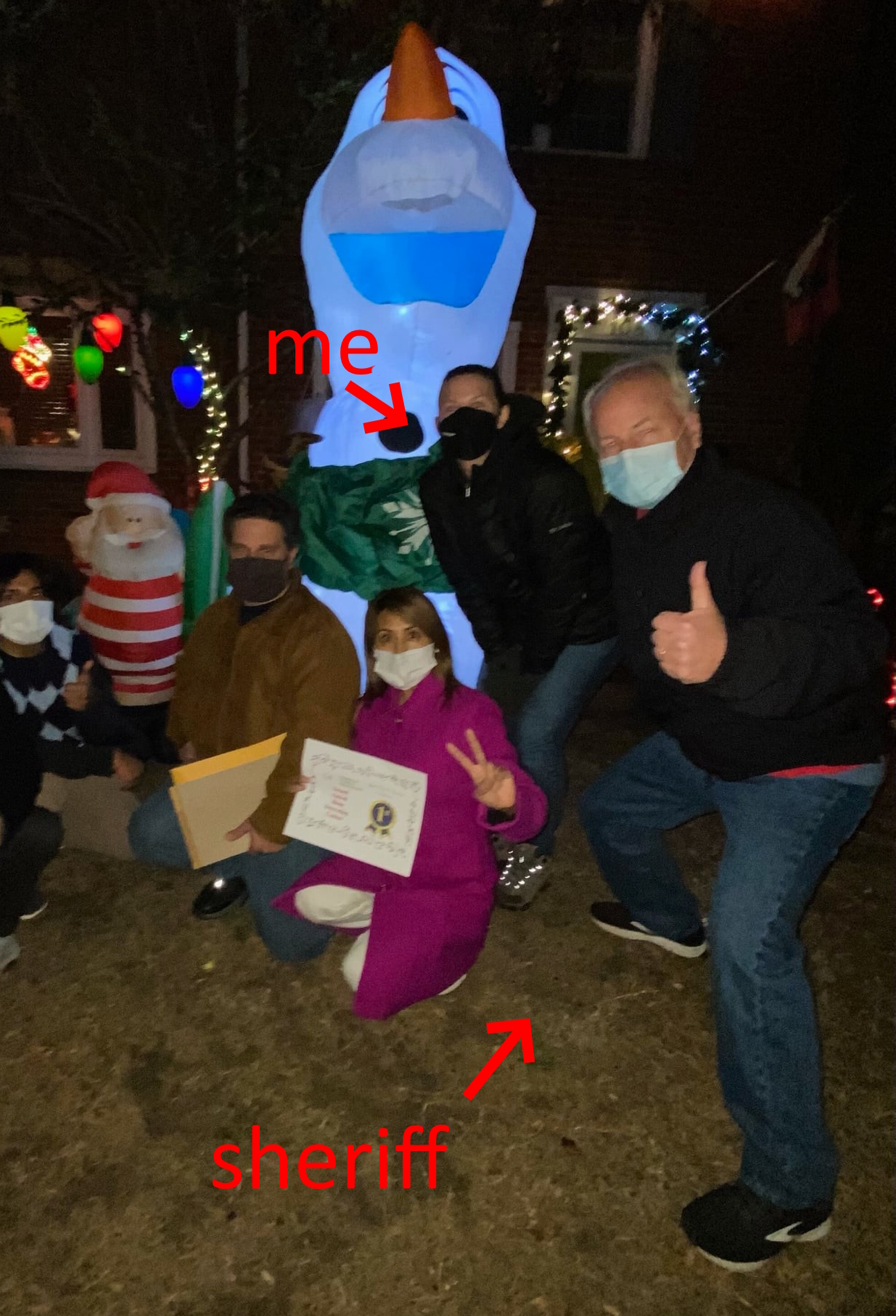
The second half of the museum was a similarly-sized room that contains temporary exhibits. Today there were two exhibits: one about the Black Lives Matters movement in Alexandria, and another one about a ceremony to commemorate Alexandria’s two lynchings. The BLM material was interesting, insofar as I was here for that (I didn’t participate for fear of covid, but I watched the protestors march past my house), so it was kinda neat seeing something I’m familiar with commemorated in a museum. I remember it well enough that I thought, “Wait, it rained that day. I remember cuz I considered offering umbrellas and/or temporary shelter to people.” This display also had much more material than the entirety of the history part of the history museum, including tons of photos, posters and other protest art, and a binder full of official comments from various city officials. There was one from our (now-retired) city sheriff, who I’ve hung out with a couple times in weird situations. Here we are delivering prizes to best-decorated houses together:
The lynching exhibit at first seemed relatively sparse, but still powerful. I’d read about this in the local news when it happened. Not when the lynchings happened, of course, but when ALexandria collected soil samples to send to the lynching memorial in Alabama. There was a video playing in the corner of the local ceremony, with speeches from local officials. And there were two “soil vessels” designed and built by local highschoolers to house and transport soil samples.
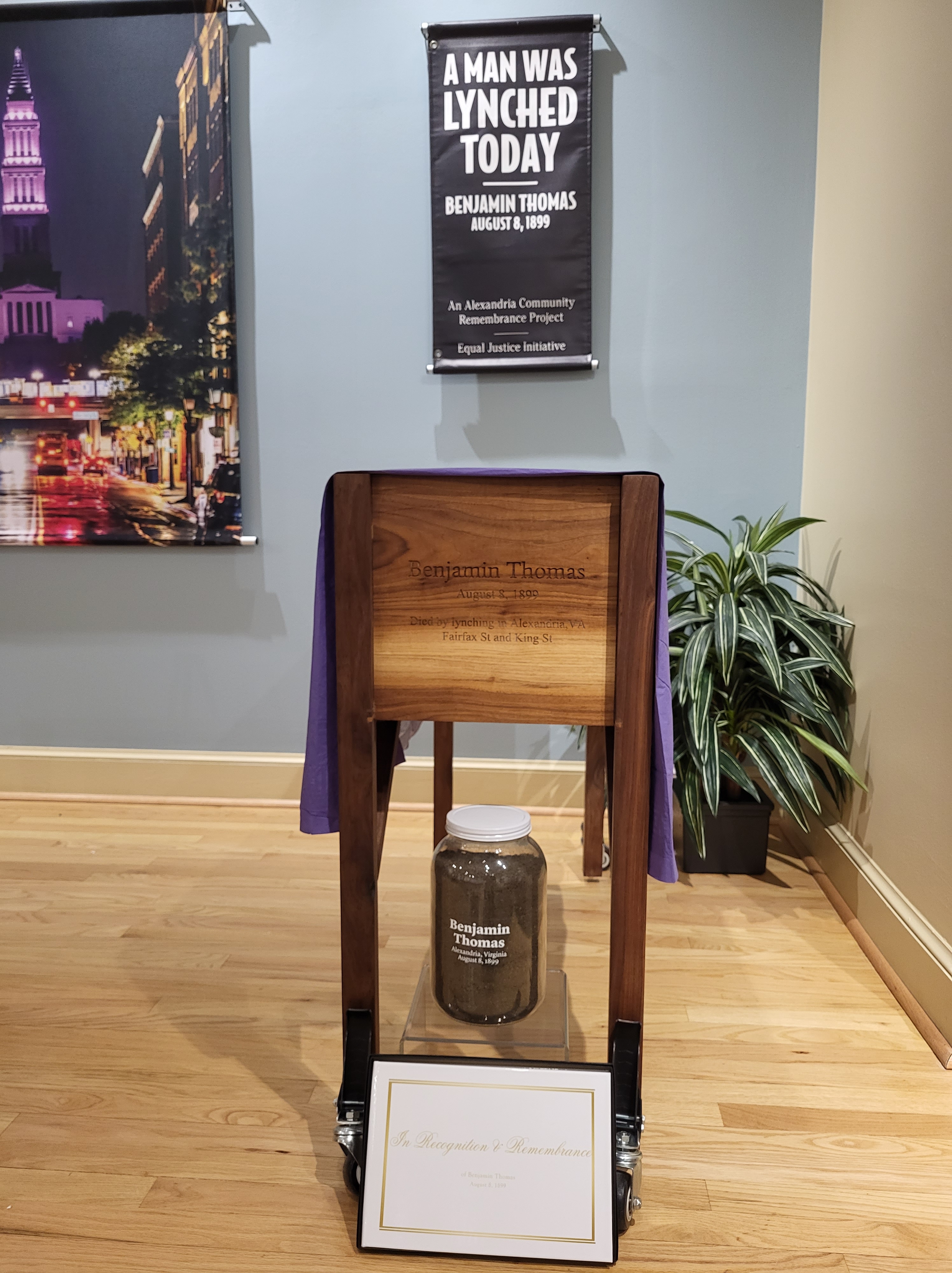
This exhibit was quite powerful, if for no other reason than it contained something actually tangible to look at, and it actually pertained to Alexandrian black history. But honestly, if I hadn’t already studied up on these lynchings and the memorial myself, I’m not sure if I would have understood what was going on.
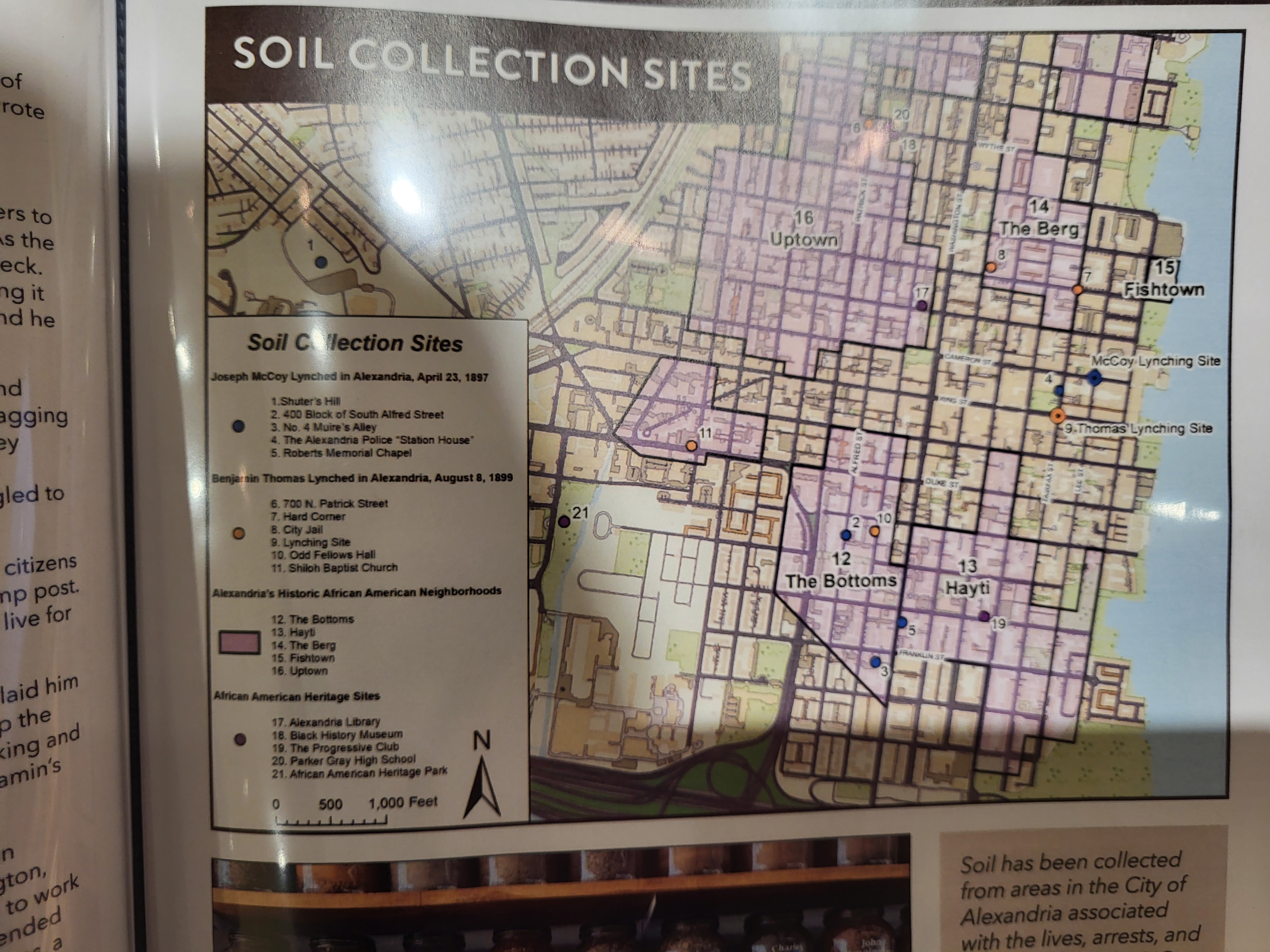
It was only at the very, very end of the entire museum that I finally found something with the detail I’d been hoping for from the entire museum. It was a sample program from the lynching memorial ceremony. That program was jam-packed with soooo much detailed history. For example, a map of locations of historical significance, such as where the historically black neighborhoods were located.
Oh, and guess what this museum DIDN’T have? Plaques about notable black Alexandrians! The thing that took a third of the slave trade museum that totally belongs in this museum instead… it wasn’t there! The closest thing was 3 plaques in the gift shop/foyer about people working to preserve local black history sites. The fact that those displays were in the gift shop instead of the actual display areas is an odd choice in my opinion.
Bottom line, I’m just really, really confused by the decision-making process involved in deciding what to display in this museum. I’m not sure who the target audience is. Full-disclosure: I’m a middle-aged white lady who already has an interest in history. So maybe I’m not the target, and maybe I shouldn’t be? But if not me, then who? Is it meant for people with zero understanding of black history? If so, this isn’t quite simple enough. Is it meant for people who understand black history but are interested in Alexandria? If so, then this has too much non-Alexandria material. Is it meant for young people with short attention spans to get them interested? If so, the kids’ display is both kinda fun if they don’t read the material, and kinda traumatizing if they only read the material, and in neither case something I think would get them to want to read more. And if it’s for teenagers, it’s just way too boring.
I really, really hate leaving such a negative review. Like I said, I’ve been dying to visit this museum for such a long time. I was so excited to engage and learn. But I learned so little here. So little. And it breaks my heart because if we can’t even learn this history in the museum dedicated to this history, then where exactly can we?
 Helga without the H