One of my new year’s resolutions this year is to visit museums. I live in the DC area, where I could probably go to a new museum every day of the year. But this past week I went on a ski trip to Pennsylvania, and something that’s been on my list since it opened roughly 15 years ago happened to be along my route home. I am of course referring to the Flight 93 Memorial.

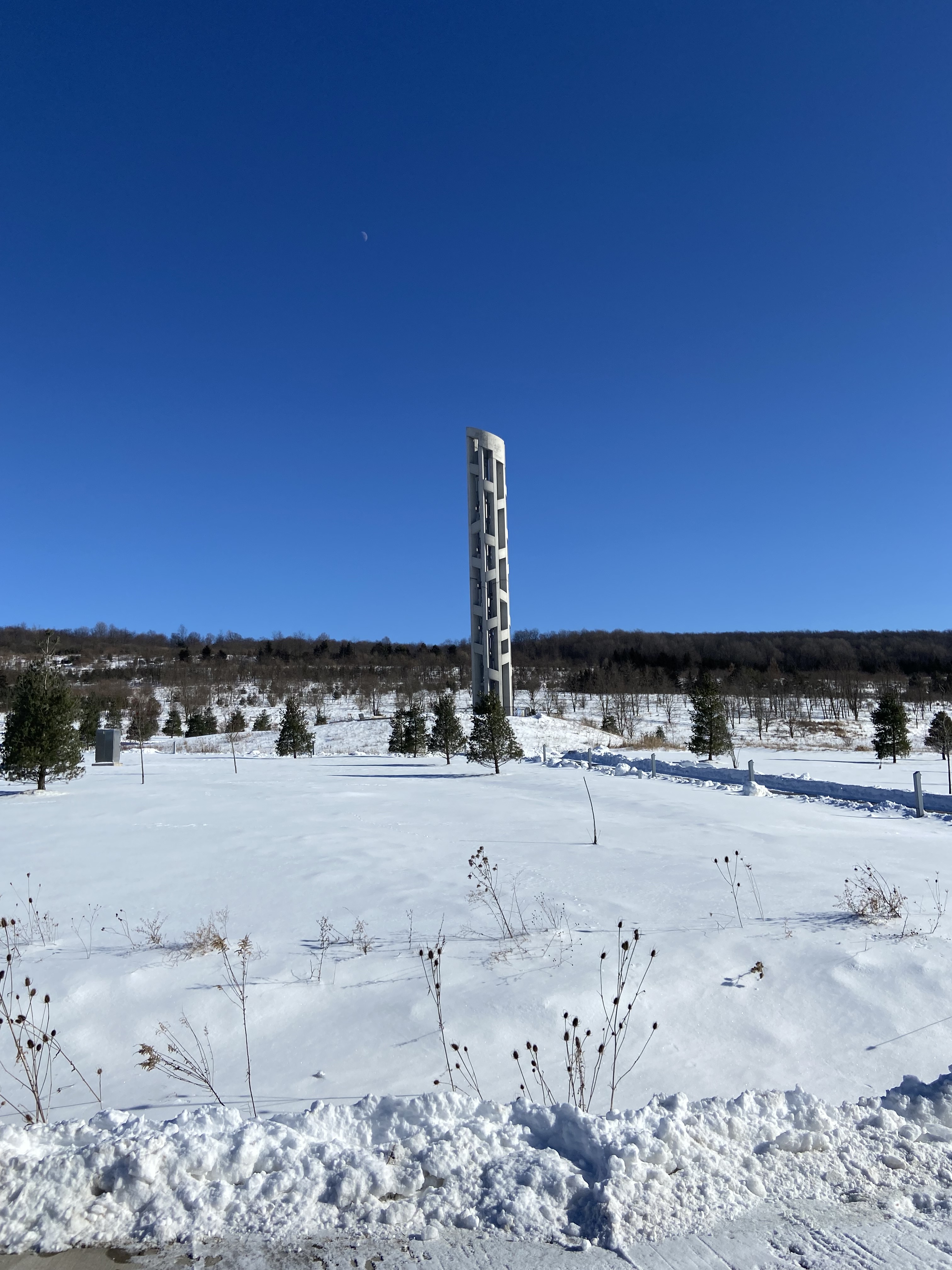
We visited on a Wednesday in mid-January, the day after a snowstorm, when the temperature was in the single-digits and lord even knows what the windchill, feels-like temperature dropped to. The memorial plaza was actually closed due to the weather, but the visitor’s center was open. Unsurprisingly, the entire place was practically deserted aside from us. But there was no entrance fee, it only added a few minutes to our return journey, and the probability of us being in the area and available again anytime soon is practically zero. So we stopped in anyway.
The visitor’s center alone was well worth the visit. Pro tip: bring some tissues. It is a very moving exhibit. Flight 93, in my experience, tends to be an asterisk when discussing September 11th. We always focus so heavily on the Twin Towers in NYC, with its mass casualties and terrifying visuals. The Pentagon crash, likewise, was in a major metropolitan area and killed hundreds of people. But then there’s also some other airplane with only 40 deaths. Nobody is purposefully dismissing the importance of this third group, but the reality is that a single plane crash is not the same attention-grabbing event as collapsing towers. And its easy to overlook an event when the location is in the middle of nowhere.
That’s why this memorial is so very, very important. The tale of the 40 passengers is absolutely incredible. Their story is absolutely insane. They were undisputed heroes, who made a courageous sacrifice to save countless lives, and acted with very little time. We, as a nation, forever owe them our endless gratitude.
A memorial is one thing. We see them everywhere, for lots of different reasons. We pause at them, maybe reflect for a moment, feel a bit sad, consider the gravity of the incident or person being remembered, and then eventually move on. That is what I was expecting to experience at the Flight 93 Memorial. It’s probably what I would have experienced if I had had the opportunity to walk down to the actual memorial plaza.
What I wasn’t expecting, though, was the incredible thoroughness and effective storytelling in the visitor’s center. In a relatively small area, the museum walks us through the story of the crash with precision. The curators selected exactly the correct amount of and type of information to share. Nothing was too wordy, but each display was packed with lessons. One thing that struck me again and again was the level of detail which we know about exactly what happened on that plane, and when. We know exactly what happened minute-by-minute. The flight, beginning to end, was very short. And every single second onboard mattered. The flight’s takeoff was delayed 20 minutes. If that delay hadn’t happened, the passengers would have been crashing into the Capitol Building (probably) around the same time as the other crashes. Instead, once hijacked, they could call loved ones who told them about the other attacks, giving the passengers the time and information they needed to realize what was happening and to make their decision to fight back.
I was surprised to learn that the hijackers didn’t bother to monitor what the passengers were up to. I’d assumed that just a couple passengers were sneaking in secret short phone calls. That any talking they were doing was whispered and fragmented. But instead there were dozens of long calls. They convened a big group vote. They clearly were having no problem with open communication and planning. Imagine if just one hijacker had bothered to supervise them and tell them to shut up? Things would have been very different. We learn all of this in the visitor’s center because they chart out for us exactly which phones calls, and how many, were placed from exactly which phone on the plane, as well as who placed those calls to whom. And the displays give very clear timelines and maps to help piece things together. The most jarring revelation in the entire display was the fact that the passengers stormed the cockpit just 18 minutes before they would have arrived in DC. Eighteen. Minutes. That’s how close we came to even more tragedy. These 18 minutes are all the more incredible when you realize just how soon after the hijacking they made up their mind to attack. They didn’t sit around scared for a few hours; they realized what they had to do almost immediately. And that gut reaction saved countless lives.
There were also plenty of details that we did not learn in the museum. And I think the selection of what to not include was also carefully curated and correctly done here. For example: we know the passengers voted on whether or not to storm the cockpit. What we do not know is what that vote count was. We should never know that. Right now, collectively, those 40 people are heroes. If there’s any record anywhere of how many people hesitated, that should never be released. We do not need to know about it. Similarly, the museum stayed away from finger-pointing, politics, or the global aftermath of the attacks. No mention of the Patriot Act, the changes to TSA regulations, the global wars on terror. All of that is relevant, of course. But that is not the focus here, nor should it be. Nothing should detract from the bravery and sacrifice of the 40 passengers and crew who gave their lives.
I’m under the impression that the curators worked with the victims’ families in deciding what to include or not include. For example, easily the most haunting exhibit was a point where you can choose to listen to phone calls made by passengers to their loved ones. They give LOTS of warnings both in writing and via audio about the content before actually playing it (you have to pick up a speaker to hold to your ear). They only play three calls, even though there were certainly more. I have to assume that they selected which calls to play or not play based on the wishes of the families, and who did or didn’t give their blessings. (Brief moment of levity; the display shows an “answering machine” and explains what that is for younger visitors.) Similarly, there is a huge display that shows photos of every single victim. At the bottom are video panels where you can click to learn about them individually. There are photos, a brief bio, and a list of memorials (for example, lots of people had post offices or parks named after them in their hometowns) for each one. I have to assume (at least I hope) that the families contributed to these displays.
There was so much more, that as I type this out I’m just awestruck realizing all over again just how much material was fit into this seemingly simple visitor’s center. I learned about local responders. I learned about the FBI investigation. I learned about the terrorist’s planning (and caught myself amazed at how obvious their plan seems with my post-9-11 hindsight, but how nobody saw it coming at the time because this attack was so unprecedented). The single most surprising thing to me was seeing images of the plane immediately after the crash; and by plane, I mean brown outline on the ground where a plane had supposedly been. I’ve seen hundreds of photos and videos of plane crashes in my life (I love the show Air Disasters), but I’d never seen anything like this. The plane basically disintegrated on impact. Normally there’s a tail or a wing somewhere. And it hit me that every single other commercial plane crash I’ve ever heard about involved pilots actively trying to avoid hitting the ground. But here, a commercial airliner’s worth of fuel were purposefully crashed into the ground at full speed for maximum death.
Maximum death. It feels melodramatic to type that out. But that’s what September 11th was all about. And yes, thousands died, and America has never been the same. But thanks to the events that ended in this Pennsylvania field, hundreds or thousands lived who otherwise wouldn’t have. One of the (many) displayed items that had me reaching for my tissue was a letter that someone had left at the memorial. It was from someone who claimed to have been staying on the top floor of a DC hotel on Sept 11th, right across from one of the likely targets. The letter-writer thanked the passengers for saving his or her life that day. As a DC-area native, whose parents were both working downtown that day, I share the same sentiments.
Bottom line: I know it’s seemingly (and thankfully!) in the middle of nowhere. But please, do find time to visit. There’s some other great stuff semi-nearby (Ohiopyle for rafting, Johnstown for flood-related history, Seven Springs for skiing, Pennsylvania Turnpike for getting to other places, etc.) It’s a story that needs to be told and remembered, and a site that needs to be honored.
*Note that no photography is allowed inside the visitor’s center. Hence my photos are all of the exterior.

 Helga without the H