Every year* I attempt (with varying degrees of success and effort) to watch as many of that year’s Oscar nominees as possible. For the past few years* I’ve posted reviews of these movies here on this blog. At some point before the awards ceremony, I usually write up some sort of over-analysis and maybe some predictions, but we’ll see if I run out of steam before then. In the meantime, today we cover…
*Except 2022, when I was too burned out from 2021’s binge to give a crap.
The Zone of Interest
[5 nominations for best picture, director, adapted screenplay, international feature, and sound]
IS IT SALTBURN? Yes. But much more serious.
Oof. This one is heavy. Be warned.
This year’s Holocaust movie is light on the Holocaust content. In fact, we never see anything happening inside the concentration camp. It might be possible, maybe, just maybe, to sit through this entire film and have no idea it’s a Holocaust movie. This would be, of course, only if you go in without any prior knowledge about the Holocaust (which most people, of course, do.) I also wondered as I was watching it how long it would take before I realized what this film was actually about and what was going on, if I had gone in completely cold with no idea what this movie was about.
Let me back up.
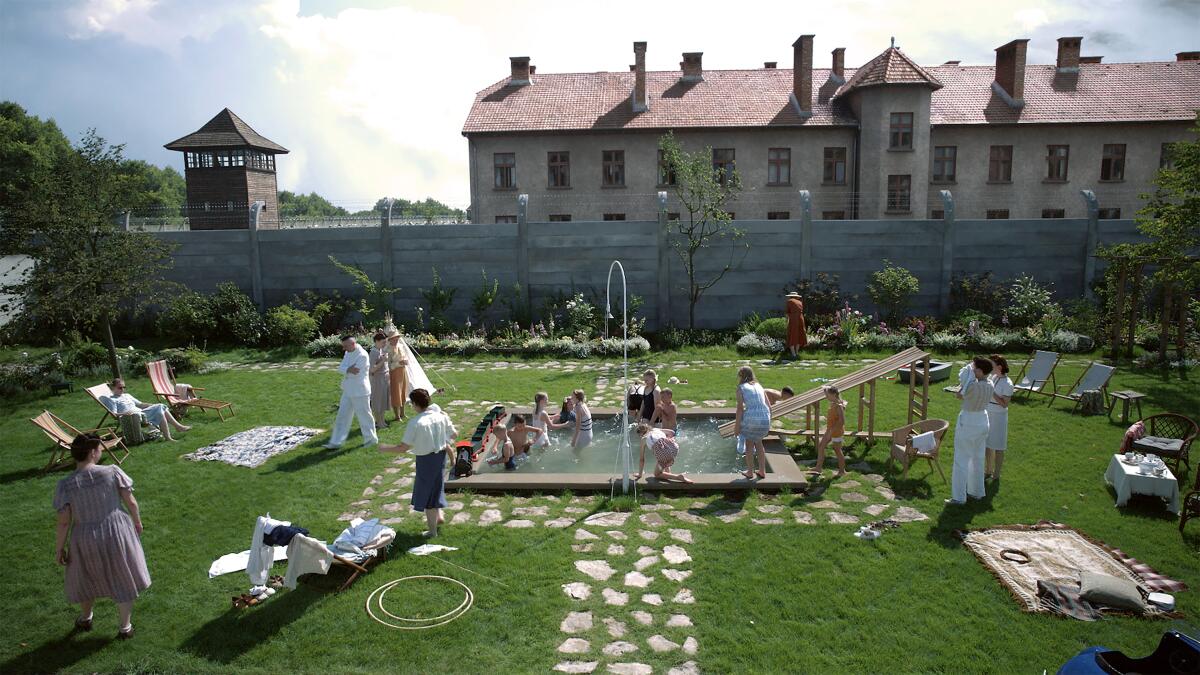
This is a film about a German family during WW2. The father is the commandant of Auschwitz, and their house is literally right next door to the concentration camp. Very literally- their Garden shares an actual wall with the camp. While the worst atrocities known to man are happening on the other side of the wall, the family is living a totally happy idyllic life. They have a little swimming pool, they grow beautiful flowers, they go for picnics by the riverside, etc. They’re upper-middle class, living in total comfort and happiness during wartime. If you are not paying attention, if you didn’t understand the context, you might think this is just a super boring family drama. There’s very little going on here in terms of plot. We start with the dad’s birthday, when the family surprises him with a new boat. Grandma comes to visit. Then the dad finds out he’s being transferred, and after a fight they decide the rest of the family should stay in their family home while the dad’s on assignment. Then (spoiler alert) the dad does such a good job doing a presentation for his bosses that he gets to come back and rejoin his family. Simple (and boring), right?
But…
Pay attention.
The film is a shining example of slow cinema (defined by Wikipedia as ” minimalist, observational, and with little or no narrative, and which typically emphasizes long takes.”) It’s basically a dark, twisted Norman Rockwell painting:

Sure, it follows a happy family through boring family milestones. If you’re just watching the main players and trying to follow the plot, you’re missing out on all the details crawling in at the edges. You could easily forget that there’s a freakin’ concentration camp on the other side of that garden wall while the kids are literally having a pool party. You can totally miss the point if you just notice that the mom and her friends are picking through new clothes if you don’t realize that the clothes came from her husband’s murder victims on the other side of the wall. You could almost be happy for the couple being reunited if you ignore that they had to mastermind the genocide of all Hungarian Jews to make it happen.
Speaking of mundane details, I had a thought in one scene that made me feel sick. There’s a scene where the dad is presenting his genocide plan to all the other Nazis around a conference room. And I thought back to my review of Rustin, where I expressed an appreciation for Rustin’s event planning skills and attention to detail. And I thought “holy shit, these scenes are similar.” For the Rustin review, I drew a comparison to the Fyre Festival and said how grateful the world should be that the March on Washington were organized by someone with that level of skills, because in less-capable hands we wind up with the Fyre Festival fiasco. But here we had someone with those exact same skills, applying them for the worst imaginable pure evil. How fucked up is it that people who have skills that could be used for good, wind up using them for this shit? Jesus.
Back to the film, the more you watch, the more difficult it is to ignore the atrocities creeping into the edges of the frame. The star player here is the audio. There’s good reason why this film is nominated for best sound. Like Oppenheimer, the use of sound here is unusual and extremely effective. While we’re having garden parties, there is a constant murmur in the background. It’s quiet and subtle enough that you could possibly miss it altogether. We watched this at home on our TV with no fancy speakers, and I wonder how much more impactful the sound would be in a cinema (for once, for once, I agree with stupid Chris Nolan. Okay, for twice, cuz I agreed on Oppenheimer as well). When you start paying attention to the murmur, you realize it’s not your usual background noise. It’s gunshots. It’s screaming. It’s the churning of machinery and incinerators. It’s the evil sound of countless people being callously and methodically murdered. I’m frank not sure how long it would have been before I noticed the noises because my husband pointed it out first. But from the moment you hear it, you can’t unhear it. As the film progresses, you hit points where you cannot ignore the sound. The most powerful example for me is the only scene where we are actually in the camp itself with the commandant; it is a close-up still shot of just his face, with the sky behind him. But we hear the sounds of the people screaming and dying around him, as smoke and ash flies around his totally expressionless face. Early on I wondered, “How aware is this family of what is actually going on? The noises are so faint and in the background, after all.” But they finally spell it out for us in a later scene where the young son is playing in his room, and then closes his window because he can hear the guards next door yelling at and then shooting a prisoner who was fighting over an apple. We hear the actual conversation, as if we’re right there (which, of course, we are.)
Sound and sight are the most obvious senses at play here, but the filmmakers use the other senses as well. We focus a lot on flowers and how nice they smell. This family’s garden is the absolute symbol of how well the family can tune out the terrors for their own benefit. There is no way that thousands of burning corpses don’t cause a smell. If there’s any doubt, we have a scene later of a family closing windows when the furnaces start up. But here we are right nextdoor, planting and sniffing flowers. One of most favorite scenes involved the mom walking the visiting grandma through the garden. If there was any doubt up until this point of just how fucked up this all is, the grandma asks, “Is that the concentration camp wall right there?” and the mom replies that year, and she’s planting XYZ flower there (and maybe discussed decorative trellises? I don’t remember the exact details.) WOW. Just gloss right over there. It’s just a wall to decorate for them. Maybe they don’t know what’s going on in there? Oh, they do. Grandma asks, “Hey, I wonder if this lady I knew from home is over there!” Oh, so they do understand that these are people. And that they are like us. And they are imprisoned. And we just don’t giveAF. The only concern is about how badly we wanted the lady’s fur coat after she got sent away, but someone else got it instead. Ha ha! What a fun little innocent anecdote! Absolutely stomache-churning.
The idea here isn’t that this is a historic drama. We’re not watching this to learn about Auschwitz or the Holocaust of the family itself (though the family is real, everything about the details of their lives is fictionalization.) Instead, it’s a story about our current world. It’s a warning about how much we can all put our blinders on and ignore the terrors of the world around us. How many times do we walk past homeless people and tell ourselves this is just how the world works? How many of our possessions originated in sweatshops? How many conflicts can we ignore? How comfortable can we feel in our happy ignorance? And how much would our lives and attitudes differ if we had a literal concentration camp in our literal backyard?
Given that this movie requires a lot of reading between the lines, I honestly felt that I probably missed a lot. I clearly picked up enough to have understood the point here and to have been pretty heavily affected. But there are also scenes where I was thinking, “Wait, what are we supposed to be getting here? What’s going on? Why are they choosing to show this to us?” I looked up a couple explainers after finishing the film to get clarity on some of it, but there are other scenes where I’m still uncertain. In theory I should want to watch this film again to see if I can figure it out, but…
This is a film that I never, ever, ever want to watch again. And I mean that in the best possible way. This is a masterpiece.
 Helga without the H
One thought on “2024 Oscar Reviews: The Zone of Interest”