I did a brief trip across the pond this past week, and managed to squeeze in a whopping 3 London museums in under 2 days! After a fascinating visit to the Churchill War Rooms and a nice scenic walk along the Thames, we headed back indoor for museum #2: The London Transport Museum!
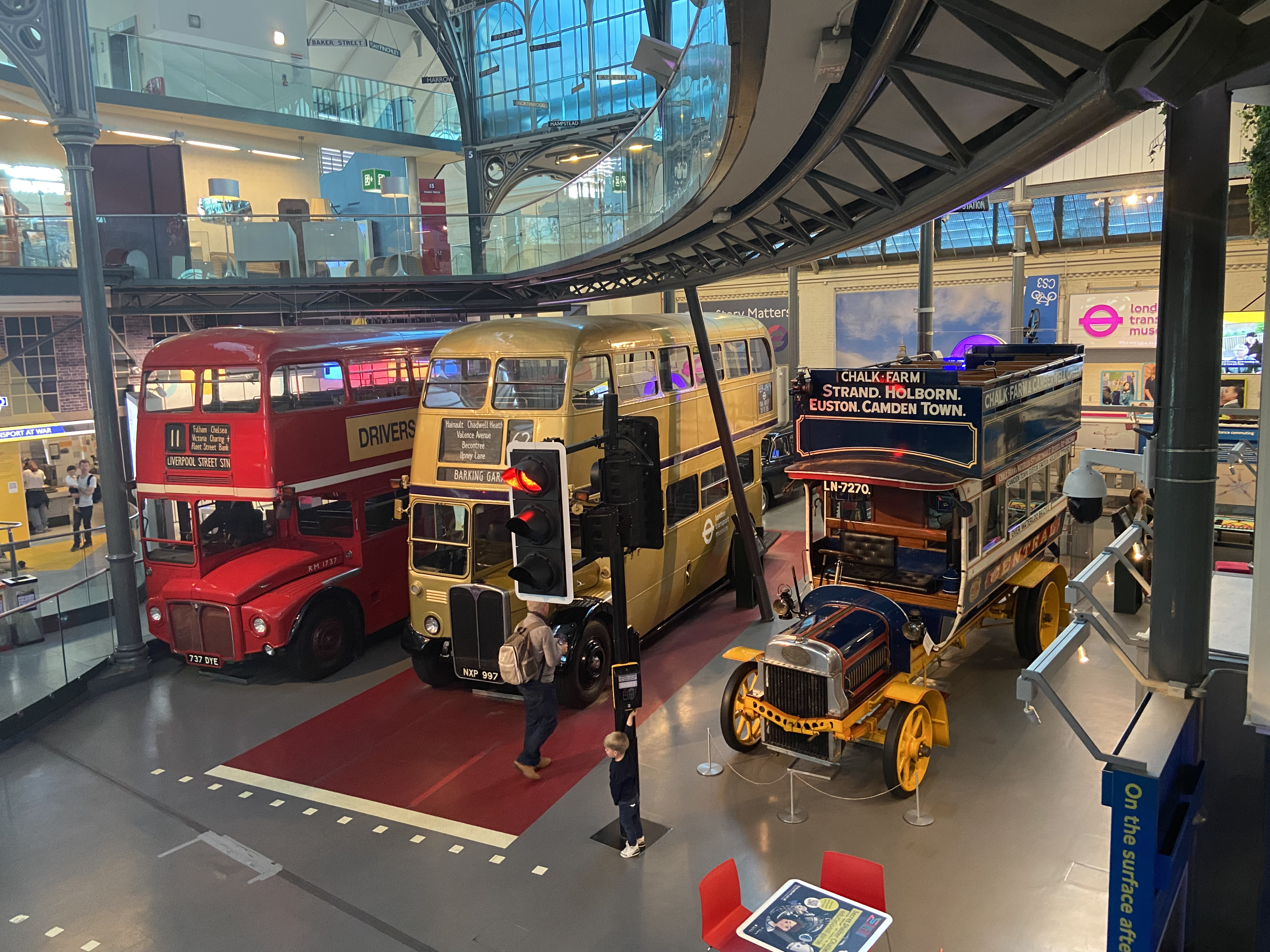
This place was great! First of all, it was very close to our hotel, which was a bonus. Second, it stayed open until 6pm (an whopping hour longer than most other museums we considered), meaning it’s the perfect second museum in a 2-museum kind of day. One thing we unfortunately didn’t see coming, though, was the ticketing and admissions procedure. This museum ONLY offers annual memberships, which means they need to take your info instead of just swiping a credit card. Not a big deal, and would be super awesome if I lived nearby, but figure the extra 10 minutes or so into your time estimates. We only started at this museum right around 4pm, giving us just 2 hours total, so that 10 minute delay was clutch.
Okay, admin and logistics are now out of the way. On to the museum itself: This place was awesome!!! Like I said, we had 2 hours there, and I could have easily added a 3rd (but probably not a 4th- it’s not that big.) The entire museum focuses on the history of mass transit in the city of London (so, not a broad overview of the history of transportation itself.) If you think that focus is too narrow, think again! London is, if you didn’t realize this, a very big city, with an astronomical population and a sprawling metropolis that goes on for forever. It’s also an insanely old city, which means lots of weird ancient infrastructure that needs to be circumvented and navigated whenever people need to move. So the history of figuring out how to move these large groups of people all over the place is, frankly, super fascinating.
We start on the top floor, which focuses on transportation in Victorian London and earlier, basically bringing us right up to the cusp before the explosion of mass transit. I started by reading about the river Thames and the history of various boats and bridges. There are also examples of various horse-drawn options, like carriages and omnibuses, etc. There’s even a sedan chair (basically, a little box a rich guy can sit in that gets carried around by two unfortunate servants.) The museum points out that, up until the last century, most people lived relatively close to their workspaces, and thus walked everywhere they needed to go. Mass transit options therefore weren’t much of a necessity. Good stuff! But that all changed with the arrival of trains.
The rest of the museum covers the lifespan of various modes of mass transit: buses, trams, commuter trains, and the underground. There were also transit-themed exhibits about posters, underground design, and, my favorite, photos comparing the London blitz with Ukrainians hiding in the subway from Russian attack. There’s a lot more to this museum than just seeing the buses and trains themselves (though that part was also very fun, especially the ones where visitors are allowed to board the vehicles and hang out with period-garbed wax statues).


The history of public transportation is also very much a history of society. For example, how does the approach towards tunnel construction differ when the digging goes through a slum vs goes through a wealthy neighborhood (spoiler alert: the poors get royally fucked)? How do commuter trains change living conditions of working people? How have authorities addressed women’s safety?
Here’s my favorite learned tidbit, because it was so topical for me on this visit; why the heck can’t you connect THROUGH London on any train lines? There’s no central station. Instead, there’s like a dozen stations that are all kinda on the outskirts, and if you want to travel from, say, Portsmouth to, say, Newcastle, you have to take the train to south London, then leave the train and get on the underground system to cross the city to a different train station in north London. It’s mind boggling for a tourist such as myself trying to plan a nice UK vacation. And behold, the museum had answers! It turns out that, when trains were first being developed, people in charge thought that they would ruin the beauty of the city. So none of the early train lines actually went into London (let alone THROUGH London!). Instead, they took riders to the countryside somewhere outside of London, and people were on their own getting into the city from there. Of course, thanks partially to the trains, London city sprawl has exploded, and now all these countryside stations are in London proper anyway. So that plan totally backfired.
The museum also seemed like it would be great for kids! Though I admit that if I did have a complaint about this museum, it’s that a lot of the more kid-friendly interactive exhibits have seen better days. There’s a kinda cool thing where they give you a little ticket card when you enter, and then throughout the museum you find little stamping stations to stamp your ticket. It was very cute, but the stampers didn’t always work so well (the first one was an ink stamp, but one was out of ink. The rest were paper cutters, but it took some adult muscle to make some of them cut.) Also, there was what WOULD have been a great exhibit to show how tram tracks reduce friction and thus make it easier for horses to pull vehicles. You’re supposed to pull on one rope to drag a heavy wheel across a regular road surface, then pull another wheel to drag another wheel across a tracked surface. Except… one of the ropes was missing. I feel like there were a couple other little examples like this, but I can’t remember. On the plus side, there’s an adorable kid play area (I think it was a little train station) that actually looked super fun (I didn’t see a single child there, but also we were there right at closing, when I’m guessing most families with young kids have already crashed.)
Bottom line: I 100% recommend this museum. It’s educational enough to for nerds like me, lighthearted and fun enough for folks who just wanna see some cool stuff, and also has plenty to hold kids’ interest. Something for everybody!
 Helga without the H