We’re halfway through the year, and when I took stock of my progress on my new years’ resolutions, I had mixed results. I’ve been right on track with visiting and reviewing enough museum for my “visit and review museums” resolution, but I noticed that I’d barely made it to any of the museums that I actually wanted to see. All those bucket-list, “Oh yeah, I should really check that out” museums were still sitting on the list, unvisited. With that in mind, I decided to utilize a lazy, scorching-hot DC Sunday to check out a museum from the top of my list: The National Building Museum.
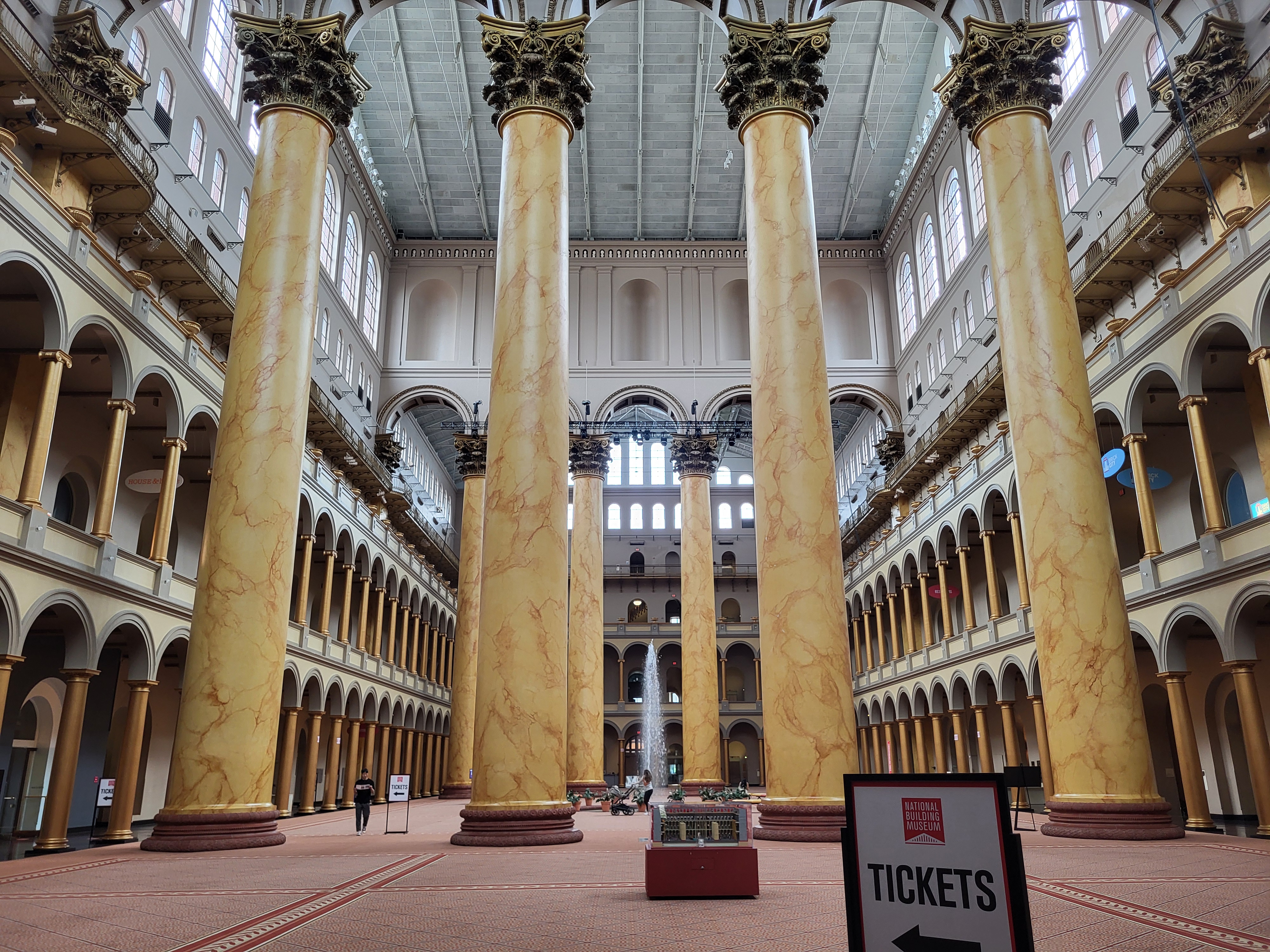
I’ve been past this museum countless times, and have even been inside before a couple times Pro tip: if you’re visiting downtown DC and need a cheap but relaxing spot to cool down during lunch, grab something to-go from Chinatown or along 7th street, and bring it into the lobby of the building museum. It’s an absolutely gorgeous, cavernous space that’s off the beaten track enough that it won’t be crawling with tourists like the National Portrait Gallery atrium (also worth a visit!) 2 block away. But to actually see any exhibits, you have to shell out ten bucks.
Ten bucks is more than the free Smithsonian museums all around town, but an absolute bargain as far as paid museums go. The National Building Museum is not in any way associated with the Smithsonian, and is run by a private entity. However, the building housing it technically still belongs to the federal government, and there is some other government involvement that helps keeps the entrance fees much lower than at for-profits museums.
I really lucked out with my timing, and arrived at the museum just in time for a guided building tour. They only had two tours that day, and I have no idea if that schedule is consistent, so I’d say definitely call ahead and make sure you’re visiting at a time when you can get the tour. It is 100% worth it! The tour is included with your measly $10 museum entrance fee, which is absolutely nutty because each one of these experiences is easily worth more than that. My visit was really divided into two completely separate experiences (both awesome): 1. The building tour, and 2. the museum exhibits.
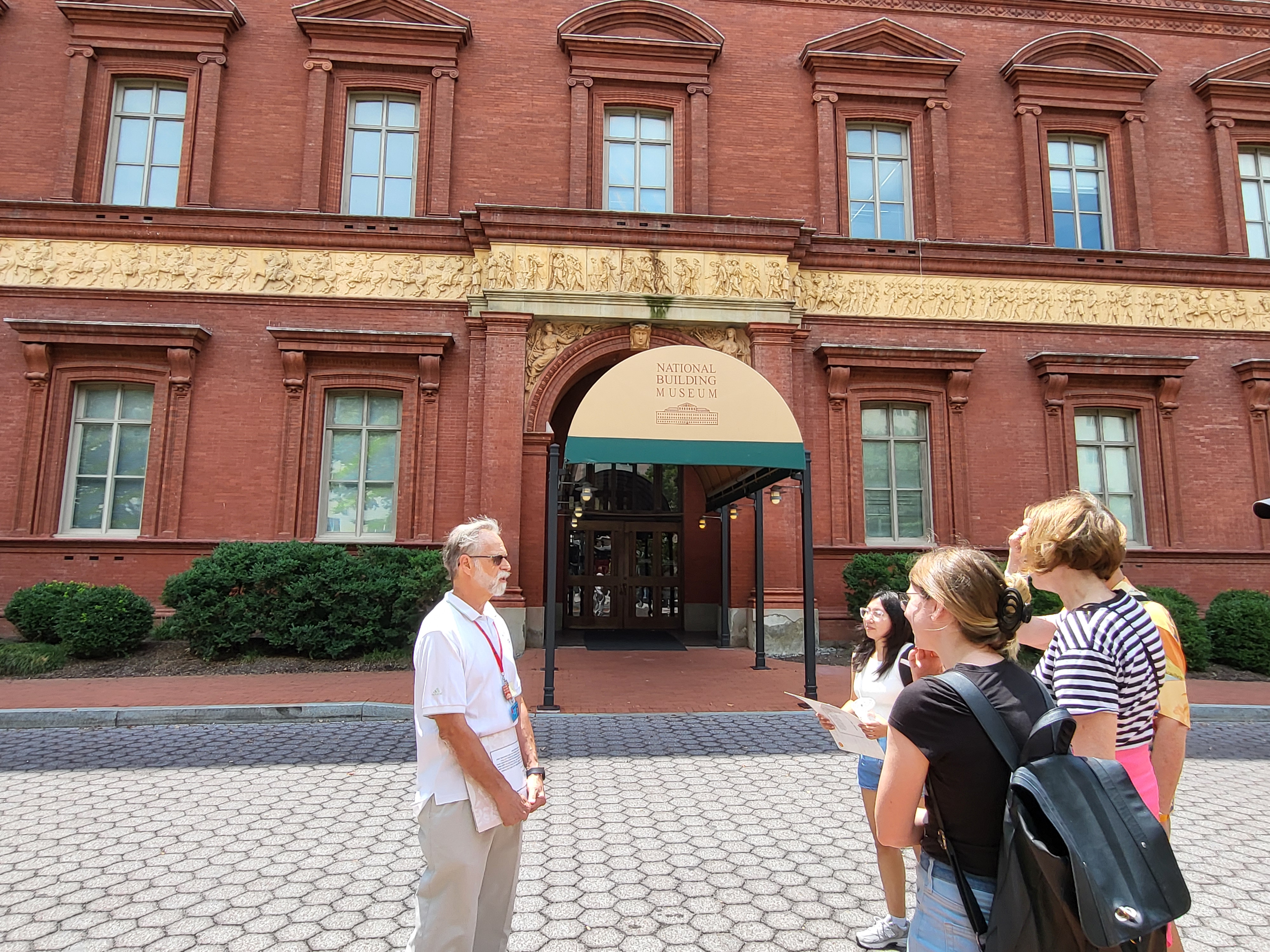
The building tour was about the history of the building itself, and I saw this with all sincerity: it is NOT for the faint of heart. Really. It was 45 minutes, with no chances to sit anyway. We start by wandering outside to look at the building’s exterior. This was peak DC heatwave time, and we were standing int he scorching sun for like 10 minutes, causing one older lady some distress.
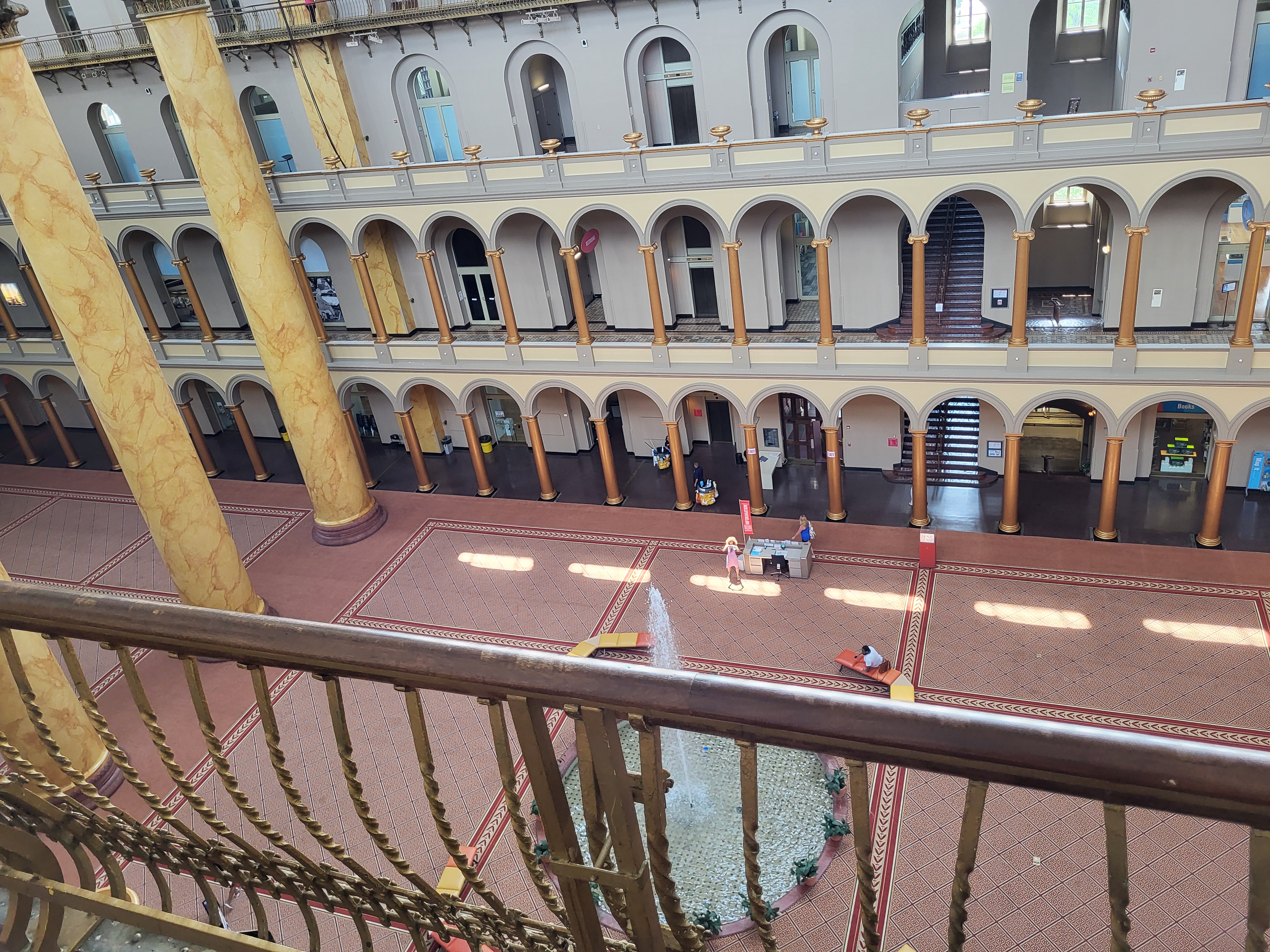
Then we took an elevator to the 4th floor, where the tour guide warned us that we might want to hug the wall if we suffer from vertigo. He was not kidding. 4th floor doesn’t sound all that high, but they are TALL floors, and the guardrail was skimpy. We were aligned with the tops of the massive interior columns looking down into the open lobby below, and we stayed there for quite a while. I was hugging the wall and starting to panic a bit, to the point where I had to sidestep my way back into the interior hallway because I was freaking out. Then we walked down two flights of weird uneven stairs (which, again, was a struggle for the older people in my group.) This all sounds like it might be a complaint, but it definitely is NOT. It’s just a legit warning that this boring nerdy history tour is NOT a leisurely stroll!
No, the nerdy tour was exciting as hell. I’m a history nerd, but I’m not really an architecture nerd, so I didn’t know how fun this would be. Holy crap it was fun! This building has an absolutely nutty history, and every square foot promoted another fascinating tidbit. Here’s the very short version: after the Civil War, there was an explosion of people who needed government pensions, so the pension bureau needed a new home. U.S. Army Quartermaster General Montgomery C. Meigs was assigned to design this thing, and he was very forward-thinking but didn’t have a lot of money. So he blatantly ripped off some old Roman designs, then cut financial corners all over the place while not cutting any substantive corners. This resulted in all sorts of wacky stuff like filling alcoves with repeated busts of dead prison inmates based on their desk masks, because he wanted busts but couldn’t afford the commission actual sculptors to craft dozens of unique busts of anyone “important.” He knew these newfangled “elevators” might come in handy, but he didn’t have the budget, so he built empty elevator shafts in hopes they’d be installed in the future (spoiler alert; they were.) He also was thinking about accessibility and environmental factors before OSHA or Green Building Standards were a think. With so many pension bureau employees and customers being amputees, he built stairs that were short and long so it would be easier to walk, he had a contrasting brick color on the edges of stairs so people with visual impairments could see (though the older lady in my group who needed assistance due to her vision said that the she hadn’t noticed), and he built in tracks along the hallway walls so that disabled employees could push stacks of paper around without having to carry them. He also focused on airflow and natural sunlight, giving the government workers working there a legitimately nice working environment, as well as a healthier one (the rate of people calling in sick from work was significantly lower in this building than any other building in the federal government.) As someone who works from a newly-built federal government building where they went out of their way to take away space, and where most of us don’t get access to sunlight, I was near tears with jealousy. Listen to all this cool stuff! And there was plenty more on the tour. Definitely go check that out.
Whether or not you make it to the building tour, you should definitely check out the exhibits. Some exhibits are permanent, others are visiting or otherwise rotating. I started in the Visitor Center, which gave some stats about people’s connection to buildings and cities. it had fun stats like the fact that we spend 90% of our lives indoors, and that the vast majority of people live in cities and suburbs. It had fun quotes like “Growth is inevitable and desireable, but destruction of community character is not. The question is not whether your part of the world is going the change. The question is how.” – Edward T. McMahon. The visitor center also had panels explaining different exterior building materials and giving examples of where and how they are used. So basically, this section was an introduction to why we should be thinking about buildings, and about the interaction between buildings and the people and environment with which they interact. I was pretty stoked when I realized I’ve actually been to many of the buildings throughout the museum, particularly in this section.
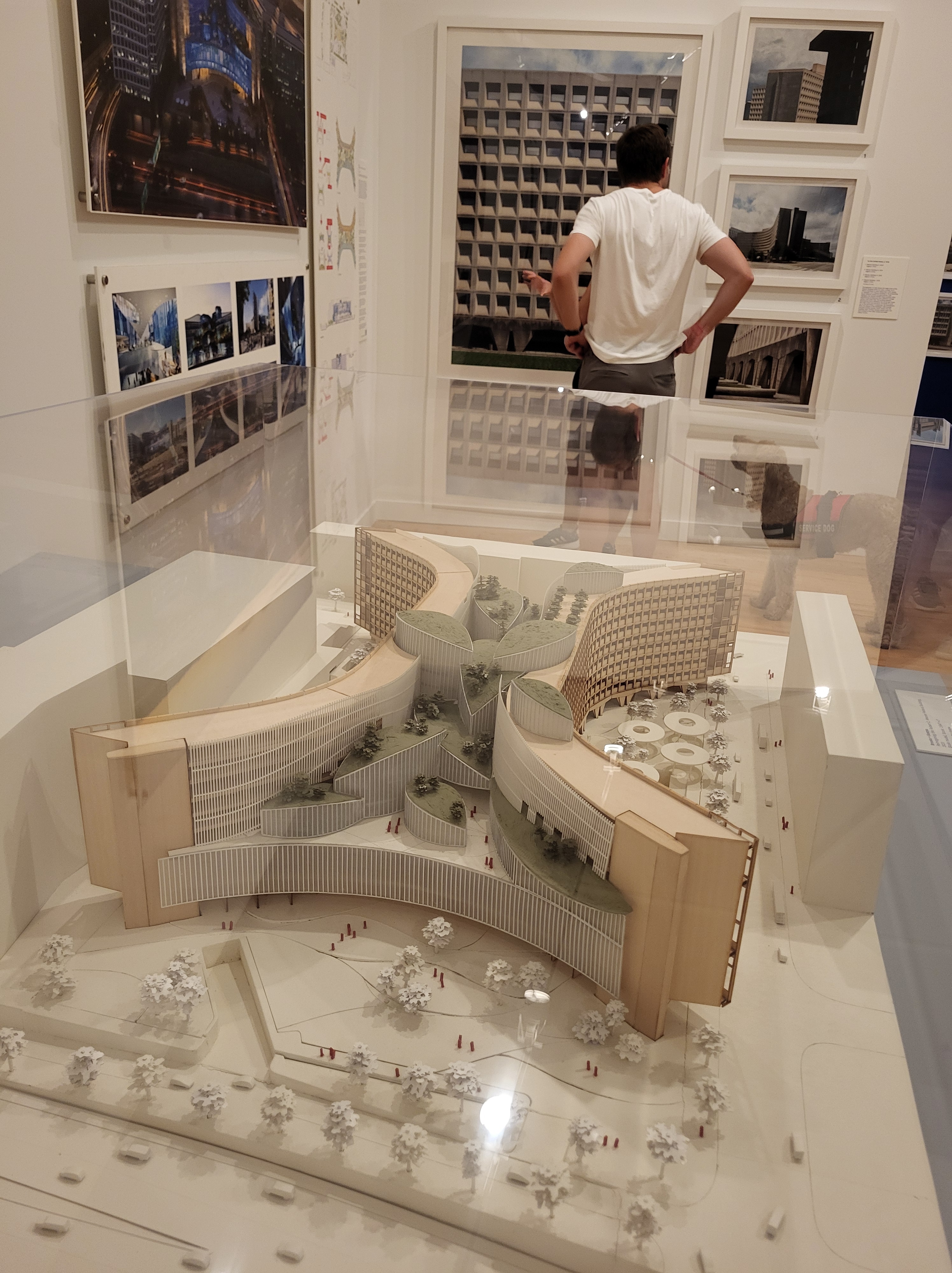
After that things got a bit less vague and more focused as I moved onto other exhibits. The first special exhibit I was stoked for was Capital Brutalism, and new exhibit set to run until February 2025. I’d heard about this one on the radio, which is what reminded me that I wanted to visit this museum in the first place. The brutalism exhibit starts with comments like “Everyone either loves or hates brutalism.” This is accurate. I very much HATE brutalism. I see architecture snobs claim that brutalism is genius if its done right. Bullshit. Brutalism is ugly, and you’re seeing the emperor’s new clothes if you think it isn’t. That being said, I was interested to see if I could have my mind changed. This exhibit had photos of a selection of ugly-ass brutalist structures around DC, most of which I recognized. For example, the FBI headquarters building is often named the ugliest building in DC, which I can assure you is 100% accurate. I’ll admit I was surprised to realize, though, that there were other examples that I recognized and realized I actually don’t hate at all. Namely, the Metro system. We’ve got some pretty dang cool-looking metro stations here in DC, and it never occurred to me that they would be considered brutalist. Maybe because they’re tubes instead of blocks? I dunno, but consider me enlightened. But wait, there’s more! The exhibit wasn’t just about the structures themselves; it was about what we can do with these ugly-ass monstrosities going forward. These buildings are often built of materials that make them costly to just knock down and replace, but there were models and pictures of architect suggestions on how some of these things could at least be altered to modernize them. It was, honestly, pretty neat. No idea if any of the ideas will be implemented, but it sure would be cool.
Next up were a couple of the least-educational but still quirky and fun exhibits. In a small room in the corner was the Mini Memories Exhibit, which was literally just a big collection of tiny souvenirs in the shapes of buildings. It was the private collection of some dude or couple (not even going to look it up) who were just really into collecting these miniatures. Fun stuff! I felt a personal connection to this exhibit because my parents always let me select some sort of souvenir figurine whenever we visited some historic building (yes, we are a nerdy family), so I definitely respected this collector’s game. Though I had to wonder if he actually visited all these places (which would be awesome) or not (which would be lame). I overheard another patron talking about how she wishes souvenir shops these days had stuff like this, which got me thinking about something I’ve noticed in my recent museum visits; gift shops suck nowadays. They’re full of all sorts of stuff that’s tangentially related to whatever the museum is about, but there is very little that has the branding of the place you’re visiting. What’s the point of a momento if it doesn’t reflect the memory you’re trying to preserve? I collect magnets of all the places I visit, and goshdarn if there aren’t some disappointing magnet selections out there. The Building Museum’s gift shop was lauded as the best gift shop in the city by our tour guide, but I just plan cannot agree; sure it was full of all sorts of crazy stuff, but what a missed opportunity to sell some actual Building Museum buildings. But I digress…
The next fun but kinda useless exhibit was called Brick City, and featured famous buildings built out of Legos. Neat! Fun! But also… not exactly educational. It was kinda cool seeing the level of detail that went into these models, and they certainly were quite impressive. But once you’ve seen a couple of these things, you’ve kinda seen them all. I’m also kinda weirded out by my recent discovery of the fact that there’s a whole world of adults out there who invest heavily in expensive lego kits and make a whole obsessive hobby out of what is essentially a children’s toy. I have similar feelings about grown adults playing too many video games. Fun stuff, but not something I’m excited about. Kids might like it, because they had legos you can play with.

I moved from the least educational to the most education exhibit: onward to House and Home! This section was all about residential buildings. The first room contained countless photographs of people in or near their homes. Lots of different homes, different people, different time periods, etc. This was fine. The next room was basically a long corridor, with 3 sections running the length of that corridor. On the left side were lifesize examples of the types of framing typically seen in American homes over time. This was the most literal depiction of buildings in the building museum. I learned a lot about how house-building has changed over time, which was cool.

I was starting to hit museum fatigue, and so decided to not bother looking at the exhibits along the right wall (it looked like just random objects one might find in a house mid 20th century. Meh.) Along the middle of the room were models of houses, always grouped in pairs: one house would be a model of a famous residence, and the other would be an economical residence that shared some sort of similar element. We could then compare and contrast how some things scale (and how some things don’t.)
By this point I was tired and hungry and overwhelmed, so I finished up by flying through the Frank Lloyd Wright’s Southwestern Pennsylvania exhibit. The first half of so of this exhibit was about Falling Water. I skipped over all of this, because I’ve been to Falling Water itself, so photos and exhibits kinda paled to just seeing the real place. There were some exhibits about parts of the Falling Water home that he never got around to building (like a car port or gatehouse maybe?), but I honestly just didn’t care. Then I hit the back half the exhibit, which was all about this grand plan Frank Lloyd Wright had for basically redefining downtown Pittsburgh. He wanted to build this absolutely insane Jetsonseque superbuilding that I can’t even figure out how to describe here. There would be penthouse apartments, and roads that tunnel in and out, and all sorts of madness. The city chose to not build it because the price tag was astronomical, and they put in a park instead. If I’d visited this exhibit earlier I probably would have been with-it enough to have retained more about this stuff. The only thing I remember was thinking, “Holy cow whaaaat?” I think of Frank Lloyd Wright as the father of midcentury modern- building kinda ugly houses that then got copied by every developer in America for a decade or so. But this Epcot Center weirdness was something totally different. It was the Yellow Submarine phase for ol’ Lloyd Wright, I guess.
I visited this museum two weeks ago, and have had a LOT happen in my life since then (hence the delayed post), but it made a solid enough impression on me that I could just recount to you every single exhibit of a 3 hour visit, and something I learned in each room. That’s saying something, I think, about the quality of this museum. It’s not one of those “you could spend all day or all weekend here” types of museums, but there is still plenty to see. The only exhibit I didn’t visit was Building Stories,” which is described as “read, create, draw, and play together as you explore our built world through the lens of beloved children’s books.” I’m on the fence about whether I would recommend this place for kids. It seems like I skipped over the exhibit they would likely find the most interesting. If they’re into legos they’ll like the lego stuff (though I wonder how long their attention spans would last just looking at dozens of lego models). But one great thing about this museum is that gigantic open lobby in the middle of the building. It has PLENTY of space for hyper kids to just kinda run around in a circle or whatever, plus a fountain. So maybe it’s good to drag them through the 2 exhibits they’d like, then let the little ones roll around by the fountain while waiting for an adult or two to get through the educational bits. For most adults, I would block 2 hours. And I would definitely get in on the building tour if possible. Ten out of Ten, would definitely recommend!
 Helga without the H
One thought on “Museum Review: The National Building Museum”