Holy smokes! WHAT A GEM! I am so glad I embarked on this museum-visiting new year’s resolution adventure, because without it, I may have gone another 3 decades without having visited this awesome museum. I’ve lived in the DC area for most of my life, and yet, I can’t recall a single time that I have ever heard anybody discuss the Postal Museum, or that I’ve seen it listed amongst recommendations for tourists. Nary a peep.
How did I wind up choosing to go here? Pure convenience. This museum is directly next to Union Station, meaning it’s a short walk from my office and directly on my way home from work. How did I even know about it? I’m not entirely certain- at some point I probably tried to find a local post office, or I just noticed it on a Google maps. I knew there was something post-office-related over there, and I’ve realized this year that tons of government agencies have some sort of lesser-known museum, and somehow I pieced together that maybe this building would have a couple displays or something inside. Turns out I was right, but I completely underestimated what I was walking into.
The museum opened in 1993 as a collaboration between USPS and the Smithsonian. Yes, this is an official Smithsonian museum, which instantly should raise expectations. It also means it’s FREE (wahoo!) The location for this place also can’t be beat. The super-convenient placement next to Union Station is intentional; mail used to travel largely by rail, so it made sense for the post office to be next to the train station. The building is designed as a companion to Union Station, which of course means it is GORGEOUS. If you do make it to this museum, be sure to pop across the street and check out the palatial great hall of the train station (come for the architecture, stay for some homelessness and stabbings!) I don’t know much of the history of the building beyond that, but in 1993 the museum moved in.

I only had about an hour to kill, so I intentionally moved quickly and strategically. The museum’s website has recommended itineraries for short visits, so I thought my hour would be sufficient. But honestly I could have easily spent 2-3x longer there. There was soooo much to learn! And plenty of cool stuff to see. The postal system is legit cool. And it’s history is fascinating.
I started in a section called “Systems At Work,” and I recommend you do the same. This was basically the section that best summarized the entire history of the post office. It was light on artifacts, but solid on information. It was pretty fascinating to hear how the service has basically always been in a race to keep up with the world around it. The expectations change over time, the delivery methods, the non-postal roles of the post offices, the technology involved. I learn about the first mailboxes, about mail tubes that ran under cities, about optical character recognition, etc. Sooo much to learn! The “Systems At Work” section and the “Customers and Communities” area are connected, and I actually didn’t realize I was moving from one to the other at one point. But, honestly they go together pretty well.
Next I moved into the big central area, which is called “Moving The Mail.” This is the section of the museum that makes for the coolest photos. They’ve got a (replica?) mail train car, a couple postal trucks, a wagon with horses, and a handful of airplanes dangling from the ceiling.

I loved the mail train, partly because the sorting boxes just to happened to include a sorting box for my tiny suburban hometown.


Moving the mail helped illustrate a point that I had learned in the “Systems At Work” section: I was surprised by how ingrained contractors have always been with the postal service. I doesn’t appear to have ever been a 100% government agency, but has always relied on a system of other delivery services to pull off their work. They’ve hired people to deliver using all sorts of weird delivery methods, like skis and kayaks. There’s of course a section about Air Mail, which started with a group of delivery pilots that were nicknamed The Suicide Club because early flying was so dang dangerous, and now is mostly contracted to FedEx.
The “Moving The Mail” section also had a creepy taxidermy dog that is listed everywhere as a cute highlight of the museum, but that I found just plain sad. I guess he was a dog who used to hang out near some postal workers, and they started attaching stuff to him, then gave him this vest so he could keep carrying all their weird heavy bling, and when he died they stuffed him so he could for all eternity be covered in their creepy charms. Very weird stuff. (To double-down on the weirdness, they have a statue of the same dog in another section of the museum for some reason. They’re, like, REALLY into this random dead dog.)

By this point I’d been at the museum for a while and was running out of time before my train home, so I picked up the pace. I wandered into the “Binding the Nation” section, which starts with a fun but thoroughly non-educational walk through a fake forest. It was supposed to reenact the earliest trails taken by messengers in colonial days, and I I’d visited this museum even a few months earlier I would have thought this was super neat, except that it reminded me way too much of part of the Bible Museum where you walk through a bible-times replica. At the end of the random fake forest there’s a section all about how news was delivered during colonial times. This information was all pretty neat; it emphasized the central role of newspapers, and how the mail was needed to deliver those newspapers, etc. This was probably the nerdiest part of the entire museum (small text, prerequisite knowledge of early American history, no dead dogs, etc.) which is probably why they tried to balance that part out with the fun but pointless walk in the fake woods.

With very little time left, I wandered into the “Mail Call” section, then just as promptly wandered out. This part was about delivering mail to the military. It might have been interesting if I’d bothered to read anything, but I obviously wouldn’t know. I just realized that I’d rather use my remaining couple minutes to skip ahead to the next section. And I am so glad that I did, because the next section was AWESOME, even when rushing through as I did!
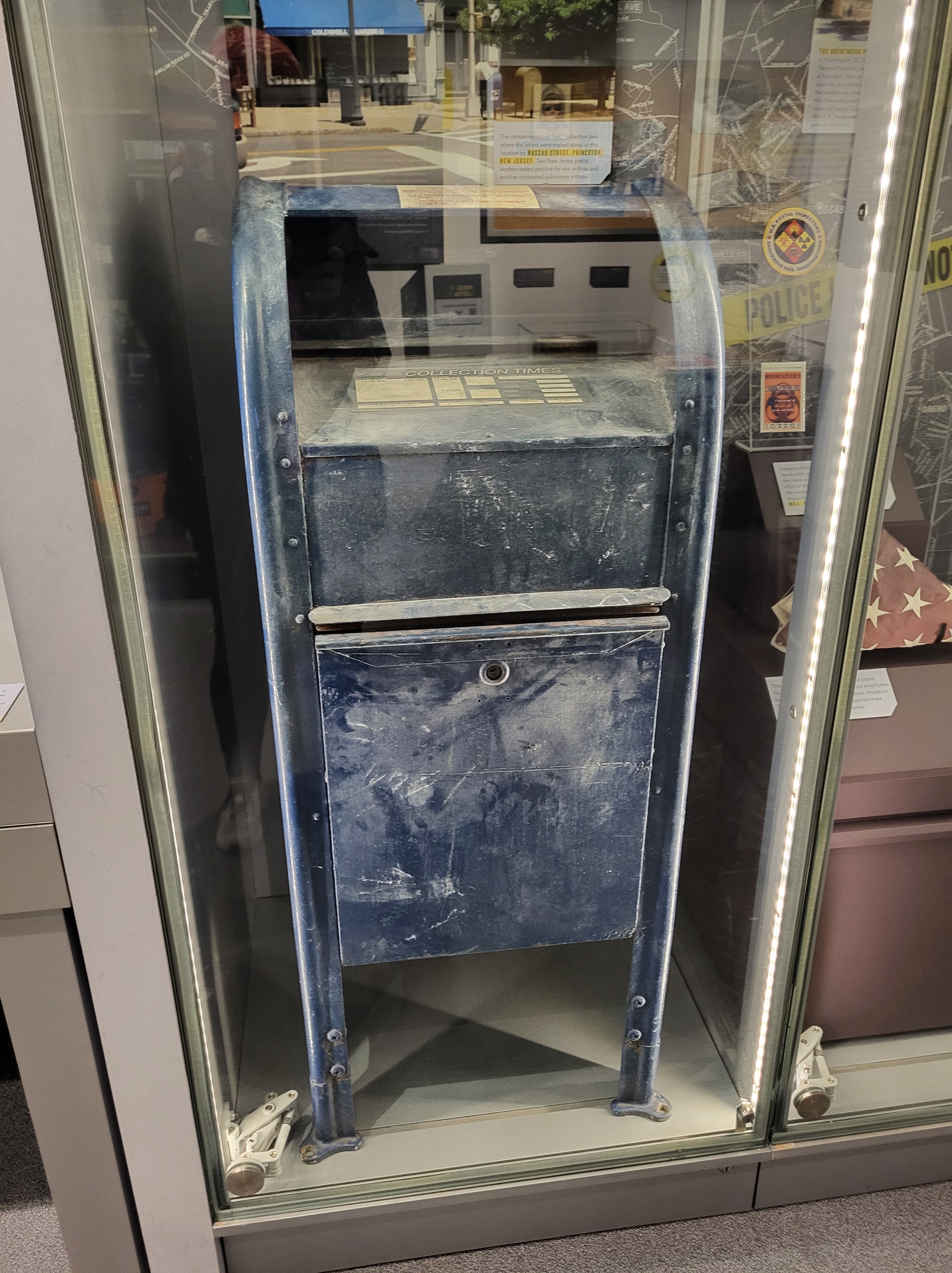
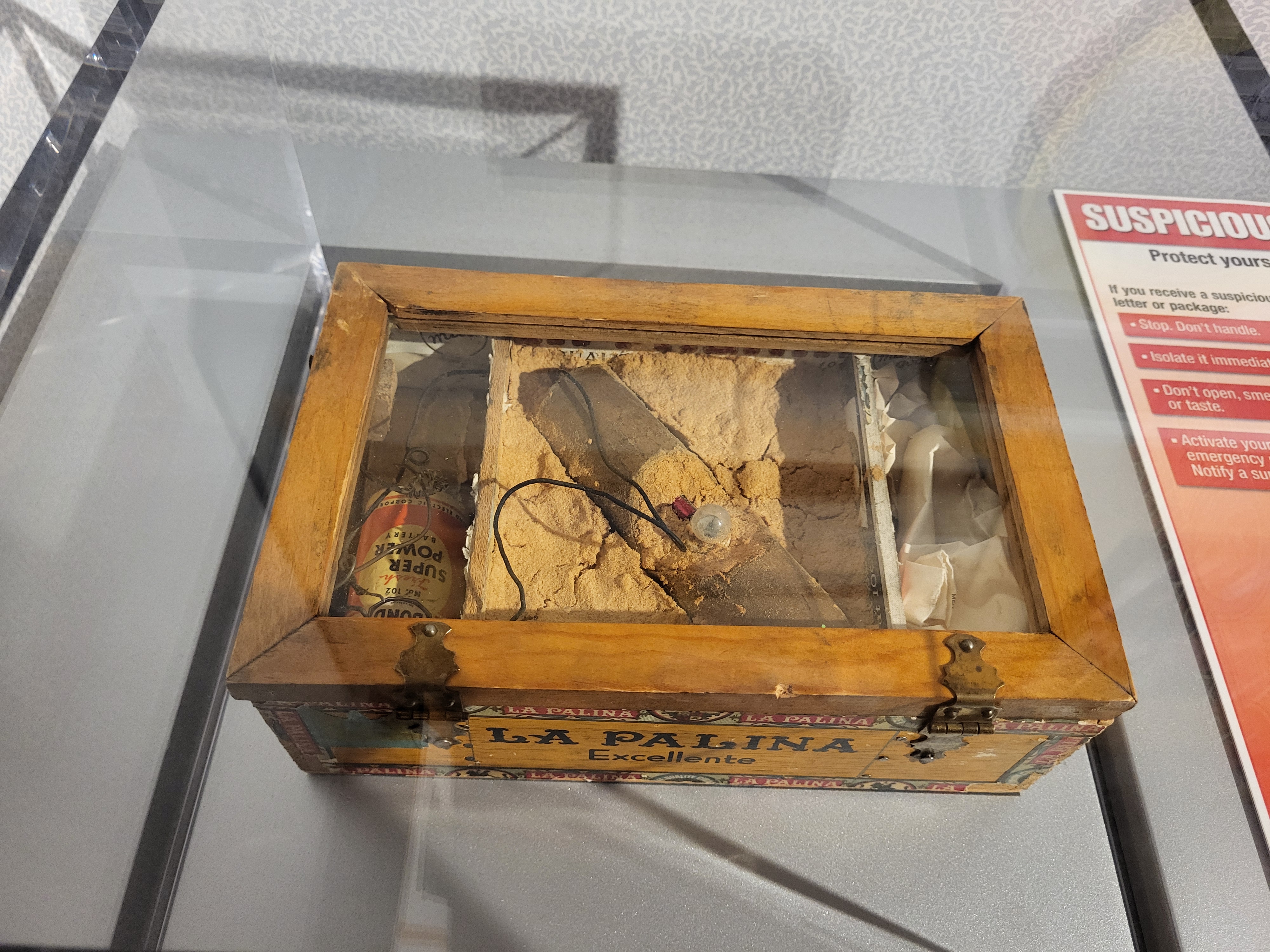
The last area I visited was “Behind the Badge,” which was all about postal inspectors. Not gonna lie, I had now expectations for this section. I’m not sure why, but I figured it couldn’t be that interesting, or that it would just feel like propaganda, maybe a bit too self-congratulatory. I’m not sure where that bias came from, but I was wrong. This section was a blast- literally! Most of the coolest artifacts in the entire museum were located here. There was a mailbox covered in anthrax, and another mailbox that had been literally shredded by a tornado (hurricane? can’t remember.) There were all sorts of illegal items they’d found in the mail, like bombs and drugs. There were all sorts of counterfeit items. I was absolutely rushing through this entire section, so it was lucky that this was the section that required the least reading and had the most visual impact. Like, yeah, I see that that’s a bomb. Neat! That being said, I definitely wish I HAD had more time here, because there was plenty of information that I barely skimmed but wished I’d been able to read at my own pace.
All of the exhibits I’ve described thus far were on Level 1 of the museum. And that’s as far as I got (barely even stepped into the gift shop!) But guess what? There’s an entire SECOND LEVEL to this museum that I didn’t even have time to pop my head into! My impression, from just glancing at the entrances as I walked past, and from looking at the museum guide, is that the second floor is mostly about stamps (whereas the first floor was mostly about delivering mail.) I have no idea if the stamp floor would have been interesting at all to someone who isn’t already into stamps. Sounds pretty boring to me, not gonna lie (and I did, believe it or not, belong to a stamp club as a kid! But one with zero comprehension of what we were doing, cuz I would do things like “laminate” the stamps with packaging tape.) I would guess that somebody who loves stamps would be in 7th heaven. But could this be one of those situations where you don’t think you’re going to be into something, but end up getting sucked in? Like any Mary Roach book? Who knows. Not me, obviously, as I had to rush out to speedwalk across Union Station to get to my platform. Point is, take this stellar museum review with a grain of salt, realizing that it’s only a review of 1/2 of the museum.
I should note that the museum also had sections on both the first and second floor that were all about baseball. I have no idea why those were shoehorned in here, but I couldn’t give 2 shits so I didn’t investigate further.
Bottom line: Don’t sleep on the Postal Museum! Are there a lot more famous museums in DC? Absolutely. But this one, though narrow in scope, has hang with the best of them. If you feel like nerding out and want something less mainstream but just as awesome as the more famous (and crowded) Smithsonian staples, definitely check this place out.
 Helga without the H